In ChildFriendly Pro's spring 2025 Director Lunch & Learn, inclusive playground design educator Tim Aylesworth of Park N Play Design said an inclusive play space must address physical, social-emotional, sensory, cognitive and communication play, and child care operator Krystal Churcher described Alberta's Inclusive Spaces Grant as a competitive, project-based program of up to $15 million that, in her account, had to be completed within 6 to 12 months and paid 50% at signing and 50% after final reporting.
What the session covered
Inclusive play design is the practice of building play spaces where children of all abilities can not only enter and move around but also take part in activities equal to those of their peers. In this Director Lunch & Learn, hosted by the Association of Child Care Entrepreneurs (ACE) with ChildFriendly Pro, Tim Aylesworth, a certified inclusive playground design educator with Park N Play Design, set out the terminology operators need when applying for grants or speaking to donors. His central distinction was that a space can be accessible without being inclusive, but cannot be inclusive without being accessible. He noted that design often focuses on visible disabilities such as mobility challenges, while, by his figures, 95% of children with disabilities in Canada have a cognitive disability, 34% a physical disability, 22% a sensory disability and 43% a communication disability, with many children in more than one category. Krystal Churcher then reviewed Alberta's Inclusive Spaces Grant, which she said was expected to reopen in May 2025 and was open to both for-profit and nonprofit operators.
What are the five elements of an inclusive play space?
Aylesworth described designing for the whole child through five elements. Physical play should offer beginning, intermediate and advanced challenge on every event, such as easy and harder climbers and slides of different heights, because child care users range from 18-month-olds needing simple options to 5-year-olds who can manage most advanced climbing. Social-emotional play includes creative and dramatic play areas that encourage socializing, acceptance and imagination, an area he said child care operators already tend to do well. Sensory play covers sight, touch, smell, hearing, taste, vestibular sense and proprioception, using varied textures, sound-making elements and colors, plus quiet, cozy spaces for children who need sensory relief, without overstimulating. Cognitive play uses puzzles and games that let children showcase what they have learned, such as letters or numbers. Communication play includes music, which he called the most inclusive element because all ages and abilities can use it, along with talk tubes, interactive panels and communication boards that non-verbal children can point to. He said some municipalities now mandate communication panels in all play spaces.
Who is eligible for Alberta's Inclusive Spaces Grant and what does it fund?
Churcher explained that the grant is provincially funded up to $15 million, competitive and project-based: applicants are funded on the resource package or capital project they submit, not on number of spaces. According to Churcher, applicants must be existing license holders. She said nonprofit and private for-profit facility-based daycares and preschools are eligible, as are dayhome agencies, though individual dayhome educators cannot apply directly. Out of school care programs are not eligible, she said, and grant money cannot be used for school-age children even within a daycare. Churcher said projects must be completed within 6 to 12 months of signing, and that professional services, mostly project administration, may be included up to 10% or $5,000, whichever is less, though she was unsure of that cap. Applications must show how the center supports at least one priority community: low-income families, Indigenous families, lone-parent families, underserved communities, families of children with disabilities, or families needing care outside standard hours. She said accessibility flooring or layout changes were funded in the first round, but not infrastructure, expansion or new construction.
What makes an Inclusive Spaces Grant application successful?
Churcher's tips were to align the application directly with the program's inclusion and accessibility objectives, give a detailed rationale and expected outcomes for each improvement, explain how it supports at least one priority community, set achievable timelines and milestones, provide an accurate budget, and define how the center will evaluate success over time. She advised using quality vendors, noting that low-cost household furniture would not help an application, and attaching legitimate contractor estimates for any capital work. She flagged two financial gaps. According to Churcher, GST was not covered in the previous round, so it must be budgeted separately, and funding was paid 50% on signing and 50% after final reporting, so centers need cash flow to finish the project. She said unsuccessful first-round applications were often not tied closely enough to inclusion goals. Churcher said she worked on 22 applications in the first round and 20 were approved, with the two declines linked to early-stage Space Creation Grant projects. She added that submission timing should not matter because applications are evaluated together and funded from strongest down.
Inclusive play design and Inclusive Spaces Grant points from the session
| Time | Key point | What centers should do |
|---|---|---|
| 03:07 | Aylesworth: a space can be accessible without being inclusive, but not inclusive without being accessible. | Use the correct terms (accessibility vs inclusion) in grant applications and donor conversations. |
| 04:14 | Aylesworth stated that 95% of children with disabilities in Canada have a cognitive disability; 34% physical, 22% sensory, 43% communication. | Plan for non-visible needs, not only mobility access. |
| 06:40 | Aylesworth: every play event should offer beginning, intermediate and advanced challenge. | Provide easy and harder climbers and slides of different heights for 18-month-olds to 5-year-olds. |
| 08:52 | Aylesworth: quiet, cozy spaces give children sensory relief. | Add a calm retreat area and varied textures and sounds without overstimulating. |
| 11:16 | Aylesworth: music is the most inclusive play element; communication panels support non-verbal children. | Include music elements and a communication board in outdoor play areas. |
| 19:04 | Churcher: the Inclusive Spaces Grant is competitive, project-based and provincially funded up to $15 million. | Submit a specific project with quotes; funding follows the project, not space counts. |
| 19:59 | Churcher: eligible are existing licensed daycares, preschools and dayhome agencies; out of school care is not eligible. | Confirm the license type and that funded items serve eligible age groups. |
| 20:36 | Churcher: projects must be completed 6 to 12 months after signing; professional services capped at 10% or $5,000, as she recalled. | Build a realistic timeline and keep administration costs under the cap. |
| 21:48 | Churcher: applicants must support at least one priority community, such as low-income, Indigenous or lone-parent families. | Document the number of families served and the community need. |
| 24:53 | Churcher: GST was not covered and funds were paid 50% at signing and 50% after final reporting. | Budget GST separately and secure cash flow to complete the project. |
How ChildFriendly Pro automates this
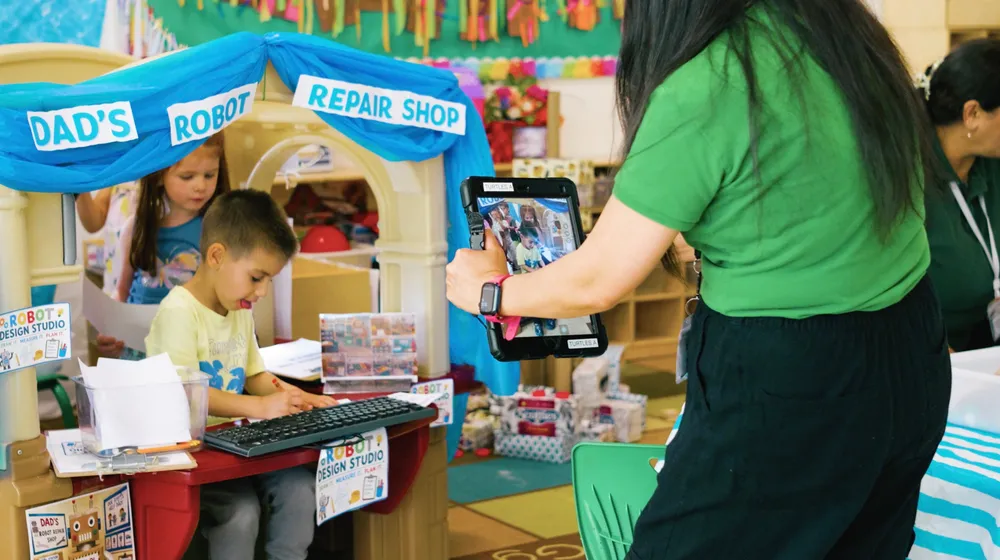
Churcher described reviewing each child's observations to decide which inclusive resources to request; at 26:23 she pointed to the ChildFriendly Pro journal feature, part of its classroom and learning tools, which streamlines staff observations, tracks each child's progress, and shares updates with parents so programming can be adjusted for every child.
Next steps
- Register for the next Director Lunch & Learn for child care operators
- Child care observation journals, portfolios and learning frameworks
- Free Inclusion Without Burnout behaviour support guides
- Book a ChildFriendly Pro demo