Two provinces. Two funding programs. One administrative problem: the enrolment file.
A child starts Monday. Her contract is signed, her fees are set, her spot is filled. Everything looks settled.
Then the reporting cycle arrives.
Your funder wants enrolment counts by age category and by program. The municipality wants numbers that reconcile against your service agreement. CWELCC reporting wants fee data for eligible children. And somewhere in the file, the health identifier you needed for the subsidy application is a note in someone's email, a photocopied card in a drawer, or a field left blank because the parent handed over paperwork at drop-off and nobody had time to key it in.
Enrolment is where Manitoba and Ontario operators feel the same pressure from different directions. The funding programs are completely different. The failure mode is identical: the record was never checked before the child started, so it gets checked later, under deadline, by hand.
Ontario: CWELCC turned enrolment data into funding data
Canada-Wide Early Learning and Child Care (CWELCC) has changed more than what families pay for child care. It has also changed what operators need to track, document and report.
Fee reductions might seem like a straightforward line on a parent's invoice, but getting that number right depends on having accurate information from the very beginning. A child's age, program eligibility, applicable fee rates and subsidy status can all affect what a family pays and what your centre is eligible to receive.
Under the Ministry of Education's CWELCC guidelines, base fees must be reduced for eligible children, as defined under O. Reg. 137/15. Licensed child care operators must also follow requirements around base fee and non-base fee limits for eligible children. At the same time, the existing fee subsidy program continues alongside CWELCC, meaning families receiving subsidies must also benefit from reduced parental contributions.
For operators, this creates an important responsibility: keeping enrolment and financial records accurate as requirements change. Municipal service system managers (CMSMs and DSSABs) also need to monitor updates to O. Reg. 137/15 to ensure ongoing compliance.
What does this mean for your centre? Eligibility isn't something you check once and forget about.
A child moves into a new age category. A family's subsidy status changes. A fee cap is updated. Each change can affect billing, funding claims and the reports you submit.
And that's where things can get complicated.
Reporting Starts With the Records You Keep
Beyond billing families correctly, operators need to be able to demonstrate that their enrolment and fee information is accurate.
In Toronto, for example, the Service Agreement between the City and a child care agency outlines the terms of funding and participation. CWELCC funding guidelines connect participation to eligible children enrolled in licensed programs.
Cost-based funding calculations can also involve base fee revenue, the different daily base fees charged for eligible children, and the number of operating spaces associated with each fee.
In other words, your funding reports depend on information you've been collecting throughout the year. Trying to piece together enrolment numbers, fee categories and attendance records from memory or scattered spreadsheets when a reporting deadline approaches is a recipe for unnecessary stress.
And the requirements aren't standing still.
The Canada-Ontario CWELCC agreement was extended to December 31, 2026, with $695 million in funding provided for 2026 to help maintain eligible fees at their current average of $19 per day. In September, the two governments also agreed to a four-year extension, alongside ongoing negotiations around Ontario's share of the $5.4 billion in federal funding announced in June 2026.
While the extension is intended to maintain current fee levels, the program may still fall short of its original $10-a-day goal.
For child care operators, the bigger takeaway is that funding arrangements, fee expectations and program requirements can continue to evolve.
The centres best prepared for those changes are the ones that already have reliable enrolment, billing and attendance records in place.
When a funding question comes up or reporting requirements change, having the right information readily available makes all the difference.
Manitoba: Managing Subsidy Eligibility, Health Information and Inspection Records
Manitoba has its own approach to child care funding and subsidies, but operators face many of the same record-keeping challenges.
The provincial Child Care Subsidy Program helps eligible families reduce their child care costs for children between 12 weeks and 12 years of age. Families apply through Child Care Online, where they register, submit the required financial documentation and receive confirmation of their application. The program also requires families to use licensed child care facilities.
There is another important piece operators need to consider: health information.
Manitoba's health registration system uses a Health Card Registration Number and Personal Health Identification Number (PHIN). Subsidy information is collected under The Community Child Care Standards Act, while personal information and health information are protected under their respective privacy legislation: FIPPA and PHIA.
This means health identifiers aren't simply another field to add to an enrolment form. They're sensitive information that needs to be collected, stored and handled appropriately.
Keeping Records Ready for Licensing Inspections
Funding and subsidy requirements are only part of the picture. Manitoba operators also need to meet provincial licensing and record-keeping standards.
The province's Best Practices Licensing Manual for Early Learning and Child Care Centres outlines requirements for maintaining child information and attendance records. Regulations also require attendance reports to be kept and made available for inspection.
Licensed facilities are inspected by provincial government staff on an ongoing basis to ensure they meet the required standards.
For operators, this means being able to do more than simply say a record exists.
Can you find a child's complete enrolment information, attendance history or required documentation when an inspector asks for it?
A spreadsheet saved on someone's desktop, a photocopied health card tucked into a filing cabinet or information entered from memory isn't exactly a reliable record-keeping system. What you need is a complete, current and organized child record that authorized staff can access when it's needed. The last thing you want during an inspection is to spend valuable time searching through folders, emails and spreadsheets for information you should already have at your fingertips.

Where the Real Enrolment and Reporting Challenges Begin
Whether you're operating in Ontario or Manitoba, many of the same administrative headaches show up when enrolment, billing and reporting processes aren't connected. And they often happen at the worst possible time: when you're trying to welcome a new family, manage your staff and keep your centre running smoothly.
Here are five common trouble spots:
1. The child's start date arrives before the paperwork is complete.
The contract is signed, the family is ready to start, but the health information is missing or payment authorization hasn't been completed. You don't want to delay a child's start, so they begin attending while your team tries to collect the remaining paperwork. Now you're chasing documents while also managing daily operations.
2. Fee eligibility is being tracked manually.
Someone on your team determines the applicable fee based on the child's age, subsidy status or current fee guidelines. But what happens when that child moves into a new age category or program requirements change? If nobody remembers to update the information, you could end up with incorrect invoices or funding records.
3. Payment authorization gets overlooked.
A family completes enrolment, but automatic payment authorization is still missing. Invoices continue to go out, but payments don't come in as expected. By the time someone notices the problem, the family's account may already be significantly overdue, leaving you chasing payments.
4. Reporting becomes a monthly research project.
You need enrolment numbers, attendance information, age categories and fee details for a funding report. But the information is spread across different spreadsheets, billing records and attendance systems. Instead of simply running a report, someone has to pull everything together, double-check the numbers and repeat the process next month.
5. An inspection uncovers missing or outdated information.
You assume a child's file is complete until someone asks for a specific document or record. Suddenly, your team is searching through paperwork and trying to determine what's missing.
These situations might seem like small administrative inconveniences on their own. But when they happen repeatedly across dozens or hundreds of children, they add up to a significant amount of wasted time and unnecessary stress.
And that's exactly why having an organized, reliable enrolment and record-keeping process matters.
The fix is a checklist that runs itself, before the start date
Manual sheets don't fail because staff are careless. They fail because nothing checks the file. Instead, the sheet just sits there, and gaps stay invisible until a report or an inspection exposes them.
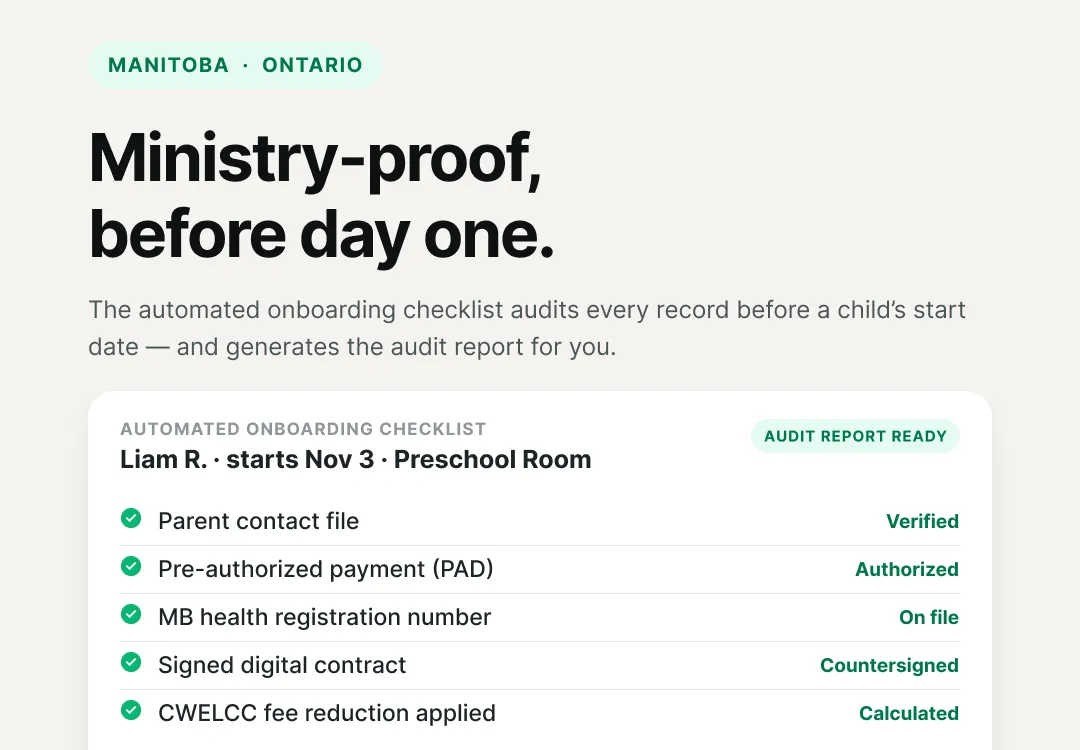
ChildFriendly Pro's Automated Onboarding Enrollment Checklist is built to close that gap before it opens. It audits a child's record before the start date, rather than after the fact, verifying the items that actually matter for funding and compliance:
Parent and guardian contact files: complete, current, verified, with authorized contacts for pick-up and communication.
Auto-payment authorizations: captured and on file before the first invoice, not chased after the first missed payment.
Regional health identifiers: the health registration and identification numbers required for subsidy and program records, stored as controlled personal health information rather than a photocopy in a drawer.
Signed digital contracts: versioned, time-stamped and retrievable, so the agreement you're relying on is the one the family actually signed.
When a record is incomplete, the gap surfaces during onboarding (while there is still time to call the parent) instead of during a reporting deadline or an inspection.
"Ministry-Proof" reports, generated on demand
The second half of the problem is retrieval. Even a complete file is useless if producing it takes an afternoon.
ChildFriendly Pro generates Ministry-Proof audit reports for instant retrieval: enrolment and documentation status pulled from the records themselves, in the format a reviewer expects, when the request arrives. For Ontario, that means enrolment, fee and eligibility data drawn from the same records your billing and funding already run on. For Manitoba, it means child information and attendance records retrievable against the licensing requirements, without reconstructing anything from paper.
The difference is important. A report you put together when someone asks for it only shows what you were able to gather at that moment. But when your system keeps everything organized and generates reports automatically, your records are always up to date and ready whenever someone needs them, even when you aren't expecting a review.
What a clean enrolment file looks like
Whatever system you use, this is the standard worth holding yourself to:
Signed agreement on file, current version, retrievable by date and signature
Complete guardian contact and authorized pick-up information
Payment method on file with auto-payment authorization captured
Health identifiers recorded and stored under applicable privacy requirements
Program, room and age category recorded accurately, with fee eligibility applied from the child's actual status
Attendance recording live from day one, not backfilled
A documented exception list: every open item, who owns it, and by when
If you can produce that for every child currently enrolled, in under an hour, you're in reasonable shape. If you can't, the gap isn't a paperwork problem. It's a process problem, and it will show up again at the next deadline.
Practical steps that hold up between reporting cycles
Run the audit before the start date, not on it. Give onboarding a hard gate: the child's record is reviewed and gaps are assigned before care begins.
Re-check eligibility on schedule. Age categories, subsidy status and fee caps change. A monthly review of enrolment and fee data catches drift while it's still one or two records.
Keep one reconciliation habit. Enrolment against attendance against billing. Monthly. The centres that do this find discrepancies in week one; the ones that don't find them during a review.
Verify requirements at the source. Funding rules, eligibility criteria and documentation expectations change. For instance, Ontario's guidelines and Manitoba's licensing requirements are both updated periodically. Confirm against current provincial guidance rather than the procedure you wrote two years ago.
Where ChildFriendly Pro fits
ChildFriendly Pro brings enrolment, billing, attendance, subsidy and grant management into one platform, so intake data doesn't have to be re-entered into a billing system and then re-typed into a report.
For Manitoba and Ontario operators specifically:
Automated Onboarding Enrollment Checklist —audits each child's record before the start date, verifying parent contact files, auto-payment authorizations, regional health identifiers and signed digital contracts.
Ministry-Proof audit reports — generated on demand for instant retrieval during reporting and inspection.
Subsidy and grant management — provincial funding tracked separately from parent contributions, so funding and billing reconcile rather than being compared by hand.
Attendance and billing in one place — the records that need to agree are stored where they already agree, not across three systems.
Software doesn't set your province's rules and doesn't make your decisions for you. You still have to follow current funding requirements, review your records and keep your procedures honest. What it can do is make the accurate version of your records the default, so compliance is a byproduct of doing your work rather than a project you take on when the letter arrives.
Book a live demo to see the onboarding checklist and audit reporting on your own enrolment data. If you're switching systems, our white-glove migration team moves your records for you, with most centres live within the week.