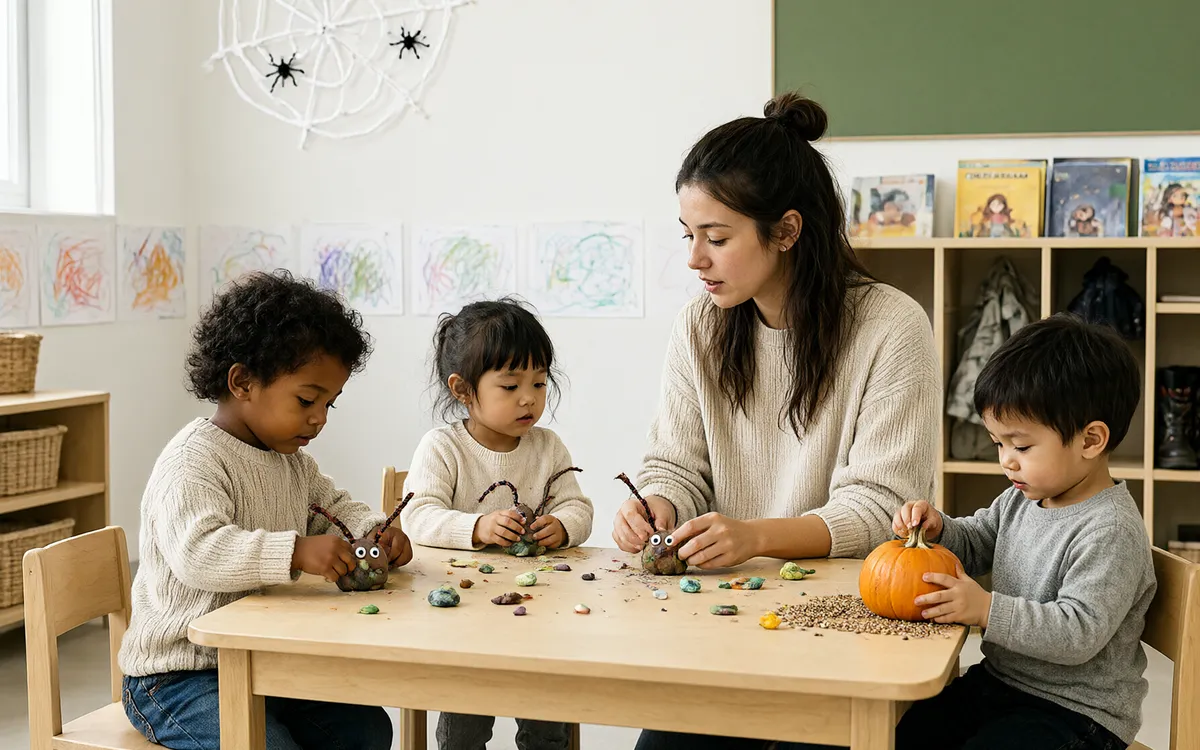
Friendly, not frightening — simple setups, five minutes of prep, and no crying at the costume corner.
Halloween is the hardest holiday to plan for with little ones. The aesthetic is built for twelve-year-olds: skulls, gore, things that go bump. Meanwhile your twos and threes are trying to work out whether a cardboard ghost is real, and whether the fake spider on the shelf is allowed to move.
The trick is keeping all the fun Halloween parts — pumpkins, magic, costumes, a little bit of silly creepiness — and dropping the parts designed to scare. Children this age love being a princess, a ghost, or a superhero. What they don't love is having a monster jump at them.
Everything below uses things you likely already have, sets up in about five minutes, and works well in a daycare. None of them require a costume, a party, or a theme. Let's dive into these fun, not-spooky halloween activities for toddlers and preschoolers.
1. Pumpkin Dig
Fill a bin with dried beans, rice, or sand. Bury a handful of small pumpkins: real ones, cut in half so they fit, or plastic ones. Add scoops, cups, and spoons, and let them dig.
What they're learning: Hand strength that becomes pencil grip later, pouring and volume ("how many scoops fills this cup?"), and vocabulary: under, buried, deeper, empty.
Setup note: Sort the pumpkins small-to-large into three baskets as you go. Toddlers will copy you once and then do it themselves.
2. Tissue Paper Ghosts
Give each child a square of white tissue paper. Show them how it floats down when you hold it up and let go. This part alone gets a laugh every time. Next, bundle it at the top with a string, draw on eyes, and hang them from the ceiling, a doorframe, or a tree branch outside.
What they're learning: Light and air resistance, plus fine motor work tying and scrunching. The floating demo is genuine scientific play, not just a gimmick.
Setup note: Tissue paper tears easily, which is the point, but give each child two or three so a ruined one isn't a crisis. Hang them low enough that children can touch them.
3. Spider Web Sticky Wall
Stretch loops of white yarn or fuzzy pipe cleaners across a wall, a window, or between two chairs to make a web. Then let children press plastic spiders, cotton-ball ghosts, small pumpkins, and paper leaves onto the strands.
What they're learning: Spatial planning such as "where does this go, will it hold, what if I put the heavy one on top?" Plus hand strength wrapping and pinching. It's also the lowest-mess activity on this list: nothing to glue, nothing to dry. Win-win!
Setup note: Pipe cleaners hold objects better than yarn and read more clearly as a web. Tape the ends to the wall so it doesn't collapse on the first load.
4. Monster Play Dough
Set out play dough with googly eyes, buttons, pipe cleaner arms, craft sticks, and cookie cutters. Let children build monsters however they see fit: one eye, seven eyes, purple, tall, short, friendly, "a little bit scary." Say what they build back to them. We love this setup inspiration from Frugal Fun 4 Boys.
What they're learning: Shape and number ("you gave it three eyes, let's count"), pressure and resistance, and creative ownership. Making a monster by hand is how a child learns they control the scariness, which is the whole emotional job of Halloween at this age.
Setup note: Homemade dough is fine, store-bought is fine. Nobody is keeping score. Roll it into a ball for them if it's too stiff on day one.
5. Counting Into the Cauldron
Give each child a small pot, bowl, or plastic cauldron and a pile of pumpkins, blocks, or plastic spiders. Count the objects as each child adds them to the pot: "One pumpkin, two pumpkins..."Let them stir, pour, and name theire potion-making rather than a maths drill.
What they're learning: One-to-one correspondence and counting. A genuine milestone:when a child counts each pumpkin as it goes into the pot, they’re matching one number to one object. Then "stir the potion" is the motivation that makes them do it five more times.
Setup note: Keep numbers under five for twos, up to ten for fours. Add a spoon and a splash of water and it becomes sensory play with counting hiding inside it.
6. Bat Wings
Trace and cut simple wing shapes from black card, or use black paper plates with a slice removed. Let the children decorate with stickers, crayon, torn paper, or glitter glue, then tape a strip around to wear. Put on music and let them "fly" around the room.
What they're learning: Symmetry, and the physical joy of running with something attached to your arms. Older preschoolers will work out why the wings have to match on both sides.
Setup note: Tape the strap closed at the back with a paper fastener rather than tape, so it doesn't snap off mid-flight. For extra fun, let them wear them to snack.
7. Black Cat Shadow Play
Tape a big sheet of white paper to a wall and shine a lamp or torch on it. Children can then make hand shadows — cats, bats, spiders, witch hats — and trace around them. Outdoors, chalk on pavement works and washes away.
What they're learning: Early scientific reasoning: predict, test, change one thing. What happens if my hand moves closer to the lamp? What if I stand up? Shadow size and shape become obvious fast.
Setup note: This activity works best in a dim room. A phone torch is brighter and sharper than most lamps.
8. Pumpkin Stamping
Cut real mini or pie pumpkins in half. Carve a simple smiley, star, or triangle into the cut face, or leave them plain and let children stamp the flat side into paint. Bottle caps, toilet rolls, and crumpled foil work too.
What they're learning: Cause and effect and the logic of imprinting : the shape made that mark, so the mark is a copy. Plus, they're learning color mixing when they stamp orange over yellow.
Setup note: Shallow paint in wide trays, not deep dishes; deeper paint makes blobs instead of prints. Pumpkin stain, so treat them as disposable or keep them for the sensory bin afterwards.
9. Friendly Trick-or-Treat Corner
Set out a basket of dress-up: hats, capes, scarves, big sunglasses, gloves, and bags. Add a paper bag house or a box with a slot, and let children knock, say "trick or treat," and receive a few stickers or pom-poms rather than candy. Rotate who hands out the treats.
What they're learning: Social skills like knocking, waiting, saying thank you, and taking one thing. Rehearsing it with stickers means the real event on Saturday is familiar rather than overwhelming. Parents will also thank you for this practice!
Setup note: Leave out a mirror. Children who won't wear a hat will often wear it the second they see themselves in it. And keep masks optional as a full face mask genuinely frightens some toddlers. Sunglasses are less intimidating than masks and are an easy substitute.
10. Candy Corn Sorting
Pour out a tray of candy corn, or plastic counting chips in three colours. Give children egg cartons or muffin tins and let them sort by color, by size, or by "pointy versus flat." Then count each section.
What they're learning: Classification, and early counting, plus color recognition. There's no wrong sort, which is exactly what makes it work across a mixed-age group.
Setup note: If you're using real candy corn, decide up front whether it's a snack or a loose part. Toddlers who mouth objects need the plastic version, and you'll want to know which ones those are.
The Not-So-Spooky Part
Some children are genuinely frightened by Halloween, and that isn't a phase to push them through. Between about two and four, the line between pretend and real is genuinely blurry and can set the stage for years to come.
If a child hides, don't coax them out. Let them watch from the edge of the room and come back when they're ready. Watching is participation. And let children make their own version of scary i.e. a monster with three eyes and a bow tie, a ghost made of tissue that floats away, because a thing they built is a thing they can control.
If your center doesn't do Halloween at all, none of this changes. They're just good activities that happen to wear a costume. Whether you call them Halloween activities or just a Tuesday morning, the goal is the same: children get to explore, create, and feel safe doing it.
And if you're spending your Halloween planning time rebuilding last year's activity binder from scratch, searching Pinterest at 11pm for ideas you'll print on Friday, you don't have to keep doing it that way. ChildFriendly Pro gives you a place to save the activities that actually worked, attach the photos, tag them by age group and learning goal, and send the parent newsletter from the same plan you built the activity in.
Next October, you'll start from what your own room already knows works.
Try ChildFriendly Pro free — no credit card, and your data migrates free.