In ChildFriendly Pro's September 2026 ECE Learning Lab, Krystal Churcher explained that educators teach community helpers best through three linked play invitations (a Community Helper Discovery basket of three to five real objects, a Community Helper Roleplay Studio for child-made props, and an open-ended Community Construction Challenge), adapted for 12–18 months, 19–36 months and 3–4 years.
What the session covered
The session applied the Learning Lab framework of Explore, Create and Build to the community helpers theme. In Explore, children observe, handle materials, build vocabulary and form theories; in Create, they represent an idea through art, construction or dramatic play; in Build, they plan, connect, collaborate and solve problems. Churcher stressed that these are not three activities that must happen on the same day but three ways of responding to one interest, so an idea can travel across the environment. She argued that children do not learn about community through job titles alone. They learn by noticing what people do, which tools they use, what problems they solve and how services connect, for example a delivery worker needing an address or a road crew affecting how a bus travels. The theme also supports coordination, receptive and expressive language, turn-taking, regulation, empathy and cooperation. Churcher advised against elaborate room transformations, noting that too many themed, adult-made materials can turn children into spectators.
How should educators set up a community helper discovery station?
Churcher recommended starting with one experience children already recognize, such as a construction site near the center, a delivery arriving or road work. Educators choose three to five related objects, for example a measuring tape, work gloves, paint brushes and an empty padded envelope, place them in a shallow basket, tray or low table, and add real photographs or a relevant book. Clipboards and paper can be added for older children. She described the next step as stopping: a small collection gives children time to compare, repeat actions and develop an idea, while introducing every item at once leads them to move quickly from object to object. Educators should allow touching and investigation before explaining, use short informational statements such as naming the measuring tape, and offer prompts like what did you notice, tell me more, or I wonder what this does. Her practical rule was to explain less during the first few minutes than feels necessary, and to observe which objects children choose and which actions they repeat.
How do community helper activities change for infants, toddlers and preschoolers?
For 12 to 18 months, Churcher recommended two or three large, safe objects such as safety vest fabric, a soft basket and board books with real photos. The focus is sensory exploration, joint attention, cause and effect, grasp and release and early language, so educators describe actions rather than test vocabulary, and carrying the basket away still counts as participation. For 19 to 36 months, add objects linked to familiar routines, such as a grocery basket, a delivery box, toy vehicles and a clipboard, and extend actions with language like you are collecting the groceries. She advised following the helpers children actually see, such as a garbage truck, snowplow, cook or grocery clerk, rather than occupations adults traditionally choose. For 3 to 4 years, add maps, community photographs, less familiar tools and a simple problem, for example a closed road the bus still needs to pass. At this age educators should value reasoning over accuracy, acknowledging a child's theory before adding information.
How should educators document learning from community helper play?
Churcher said educators often undervalue the learning in simple activities, writing only that a child enjoyed a community helpers activity. She modeled a short observation: a child placed blocks in a row, named it a hospital, added a road and an ambulance, and, when a peer asked where people would park, moved blocks to make a parking lot. That single observation provides evidence of vocabulary, symbolic representation, spatial awareness, planning, problem solving and collaboration, and suggests the next invitation, such as parking signs, a community map or photographs of accessible entrances. Educators do not need to name every developmental domain in every observation, but documentation should inform planning. For the Build invitation with preschoolers, she described a progression of plan, build, test, revise and explain, and recommended introducing one challenge at a time, such as a closed road or a new family needing a home. Revisions are high-value learning, so structures should not be protected from change and can stay up for several days.
Community helpers Explore, Create, Build setup from the session
| Time | Key point | What centers should do |
|---|---|---|
| 02:20 | Explore, Create and Build are three responses to one interest, not three activities on one day. | Let one community interest move across discovery, art and block areas over several days. |
| 06:39 | Churcher: too many themed materials make children spectators; three useful objects beat 20 plastic toys. | Start small with open materials such as tape and blank cardboard. |
| 09:11 | Churcher recommended choosing one recognizable experience and three to five connected objects, then stopping. | Set up a shallow basket with real objects and photographs near the block area. |
| 10:48 | Explain less in the first few minutes than you think you should. | Observe which objects children choose before teaching. |
| 11:12 | For 12–18 months, offer two or three large safe objects and describe actions instead of asking questions. | Use responsive language such as you put it in the truck. |
| 15:55 | For 3–4 year olds, value reasoning over accuracy. | Acknowledge a child's theory, then add information. |
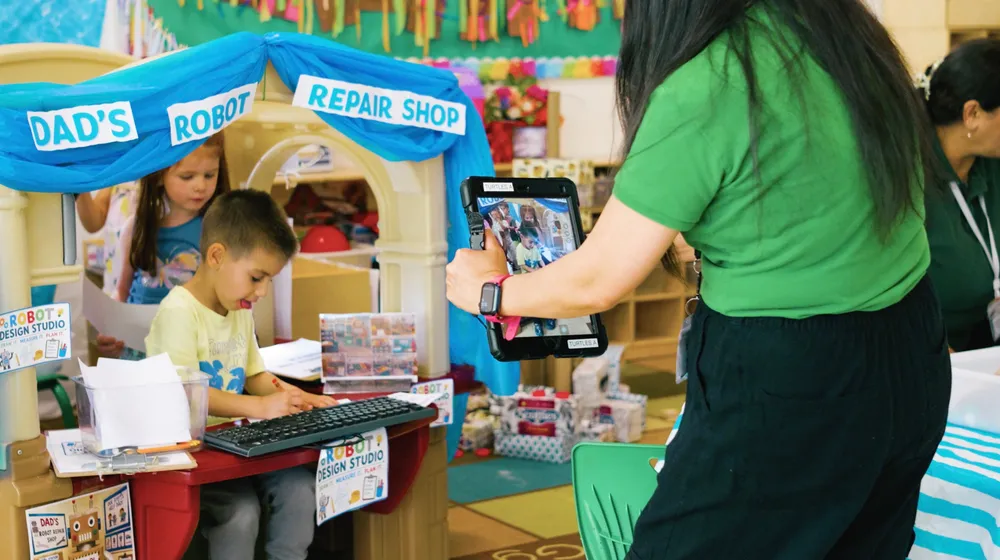
| 16:57 | The Roleplay Studio is a maker space beside dramatic play with paper, cardboard, tape and recycled containers. | Let children make the props their play needs instead of cut-and-paste crafts. |
| 22:39 | Preschool props can include menus, work orders, maps, receipts and bus tickets; spelling is not the measure. | Look for planning, negotiation and purposeful use of what children make. |
| 30:43 | Preschool building follows plan, build, test, revise and explain, with one challenge at a time. | Leave structures up for several days and pose problems like a closed road. |
| 31:51 | Documentation should name the learning, not just say a child enjoyed the activity. | Write short observations that list vocabulary, planning and collaboration, and use them to plan the next invitation. |
How ChildFriendly Pro automates this
Churcher contrasted vague daily notes with detailed observations that explain learning to families, and mentioned sending those updates through an app such as ChildFriendly Pro (33:21). ChildFriendly Pro's Classroom & Learning Tools link observations to frameworks and portfolios, and its AI features help educators draft learning stories; no product demo was shown in this session.
Next steps
- Free ECE Learning Labs and professional development certificates
- Free Community Helpers Learning Lab guide
- Child care portfolios, lesson plans and framework tools
- Book a ChildFriendly Pro demo