Skip to content
ChildFriendly Pro
Free templateAdministration

Guiding Children’s Behaviour Policy Template

A three-page sample child guidance policy built on a positive, non-punitive approach: the objective and philosophy, the environment, ten prevention strategies, sixteen intervention strategies with example phrases, caregivers’ responsibilities and a list of prohibited practices.

Format
Printable PDF · US Letter
Pages
3
Best for
Directors · owners · all staff
Updated
Oct 2026

No sign-up required. Print it and share it with your team — it’s free for any child care program to use.
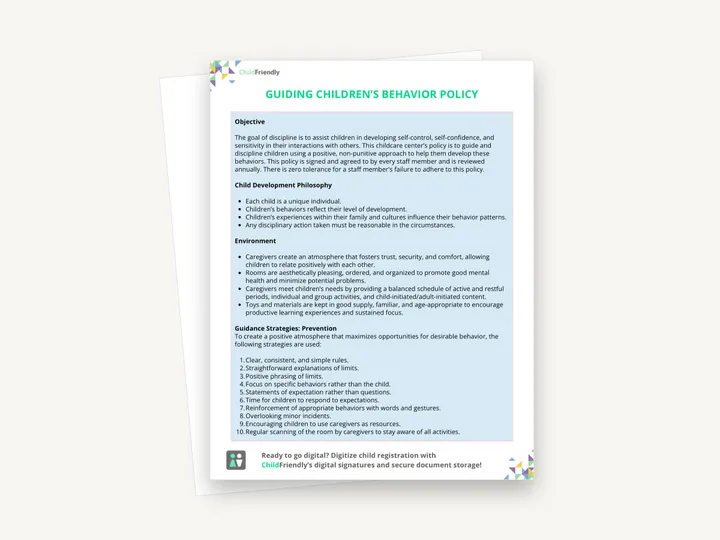
Preview of the Guiding Children’s Behaviour Policy Template

What’s inside

From philosophy to the words staff can use

  • Objective and Child Development PhilosophyThe goal of discipline — self-control, self-confidence and sensitivity towards others — and four principles, including that children’s behaviors reflect their level of development. The objective states that every staff member signs the policy and it is reviewed annually.
  • EnvironmentHow caregivers and rooms reduce problems before they start: an atmosphere of trust and security, ordered rooms, a balanced schedule of active and restful periods, and a good supply of age-appropriate toys and materials.
  • Guidance Strategies: PreventionTen strategies, such as clear, consistent and simple rules, positive phrasing of limits, statements of expectation rather than questions, overlooking minor incidents and regular scanning of the room.
  • Guidance Strategies: InterventionSixteen strategies, many with a sample sentence — acknowledging feelings before setting limits, offering appropriate choices, natural and logical consequences, redirecting, and what happens when a child is removed from a situation or the Director is called.
  • Caregivers’ Responsibilities and Child Care Licensing RegulationsSix staff expectations, including reporting breaches and notifying parents and the Director of persistent problems, followed by four things caregivers must not do: physical punishment or degradation, denying basic necessities, restraint, confinement or isolation, and lifting or carrying a child outside listed exceptions.

How to use it

Four steps to put it to work this week

  1. 1
    Read it against your regulationMost jurisdictions set out what a child guidance policy must contain and which practices are prohibited. Check the sample section by section.
  2. 2
    Rewrite it as your ownThe PDF refers to ‘this child care center’ throughout and is not editable. Retype it with your program’s name and adjust the wording to match how you work.
  3. 3
    Decide the staff consequencesThe sample states zero tolerance and termination for certain breaches. Make sure those clauses agree with your employment contracts and local employment law.
  4. 4
    Train on it, sign it, review it yearlyWalk through the intervention examples at a staff meeting, have each staff member sign your version, and set an annual review date.

Tips from operators

What centers that use this well do differently

Learned the hard way across 3,000 child care spaces — and from the directors and educators who join our Lunch & Learns and Learning Labs.

Practise the example phrases

The intervention list includes ready-made sentences such as “Do you want to wait here for your turn, or do you want to find something else to do?” Role-play them so they come naturally in the room.

Check the ‘time away’ wording

Strategy 15 describes removing a child from a situation, while the licensing section prohibits isolation. Confirm how your regulation draws that line and say so plainly in your version.

Share it with families

Put the policy, or a summary of it, in your parent handbook so families know how behavior is guided and when they will be contacted.

FAQ

Questions about the Guiding Children’s Behaviour Policy

Can’t find your answer? Chat with a real person who has run a child care center.

Read more FAQs
Does this meet my licensing requirements?

Not automatically. The section headed Child Care Licensing Regulations lists general prohibitions but does not cite any specific province’s or state’s regulation. Use it as a draft and adapt it to your own licensing rules.

Is there a signature page?

No. The text says the policy is signed and agreed to by every staff member, but the PDF has no signature or date lines. Add an acknowledgement page to your own version.

Does it cover biting or other persistent behaviors?

Briefly. Caregivers are expected to notify parents and the Director of persistent problems such as biting or swearing, work together on them and document the problem in an incident report. There is no separate step-by-step plan for specific behaviors.

Why is it spelled ‘behavior’ in the PDF?

The document itself uses US spelling — its heading is ‘Guiding Children’s Behavior Policy’. Change the spelling to suit your program when you retype it.

Keep learning

Related resources from the Academy

Newsletter

Get every new template the week it’s released

We add new templates and tools most months. Subscribe and they land in your inbox — along with Lunch & Learn and Learning Lab invitations.
  • New templates and classroom tools as they’re published
  • Invitations to free Lunch & Learns and Learning Labs
  • Licensing and funding updates for your province
  • No spam — one email a month, unsubscribe anytime
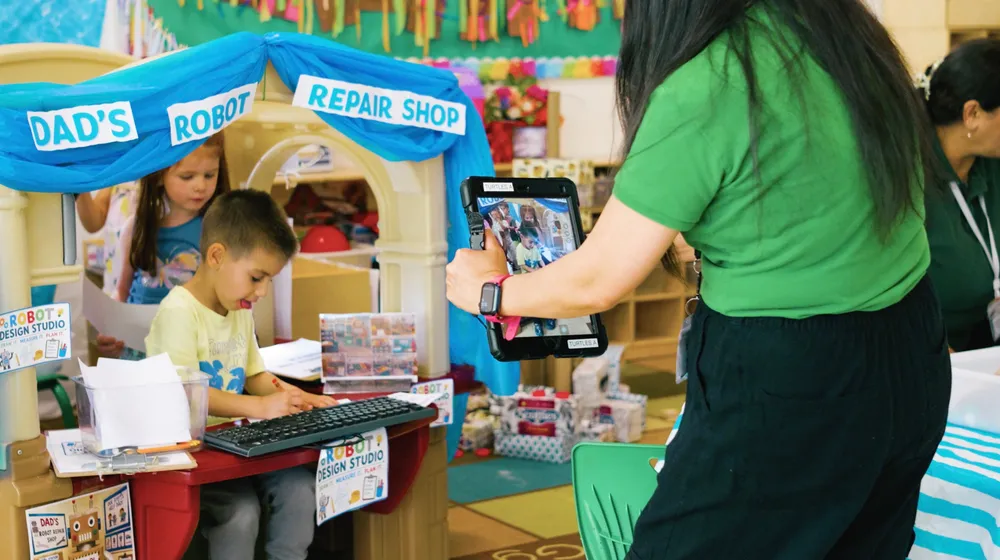
An educator taking a photo of children playing at a pretend shop

Get more from ChildFriendly Pro

Join hundreds of child care professionals across North America. CASL compliant.

You can unsubscribe anytime. CASL/CAN-SPAM compliant.