Write down the time
The guide asks you to watch the times of day children struggle most. A time on each note makes those patterns visible.
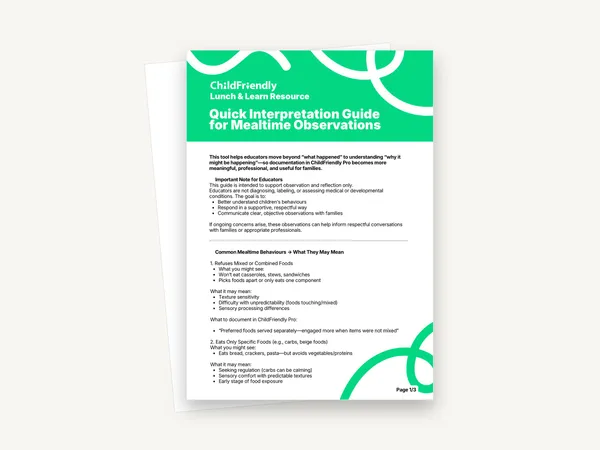
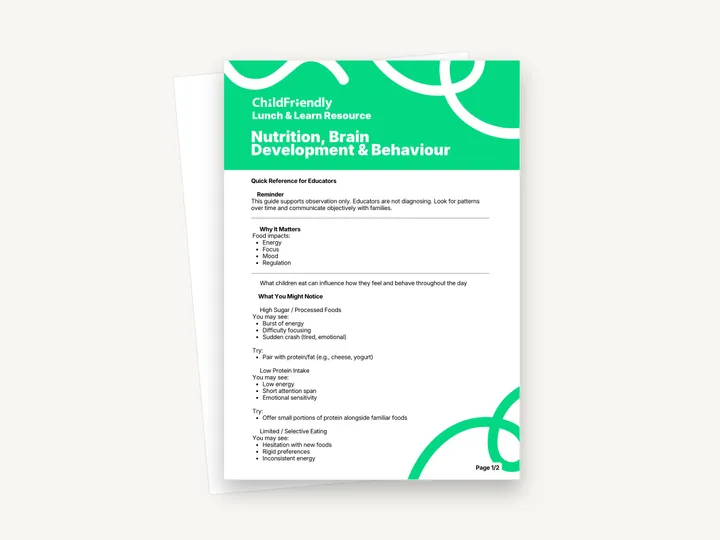
A two-page quick reference for educators from the ChildFriendly Lunch & Learn series. It lists what you might notice in children’s energy, focus and mood in five eating situations, with a short “Try” suggestion for most of them. It supports observation only — the guide states that educators are not diagnosing.
No sign-up required. Print it and share it with your team — it’s free for any child care program to use.
What’s inside
How to use it
Tips from operators
Learned the hard way across 3,000 child care spaces — and from the directors and educators who join our Lunch & Learns and Learning Labs.
The guide asks you to watch the times of day children struggle most. A time on each note makes those patterns visible.
Tell families what you saw and when. Leave it to them and their health provider to decide what, if anything, it means.
The guide describes a balanced meal as protein + fat + carbs. Check whether your snacks and lunches usually offer all three.
Do it digitally in ChildFriendly Pro
Build the same plan in ChildFriendly Pro and every observation you log is tagged to FLIGHT, ELECT, ELF or your own outcomes, added to each child’s portfolio and shared with families in their daily journal.
FAQ
Can’t find your answer? Chat with a real person who has run a child care center.
Read more FAQsNo. The guide says it supports observation only and that educators are not diagnosing. It is a prompt for what to notice, not a replacement for advice from a doctor or dietitian.
Educators — it is subtitled “Quick Reference for Educators”. Directors can also use it as a discussion starter at a staff meeting.
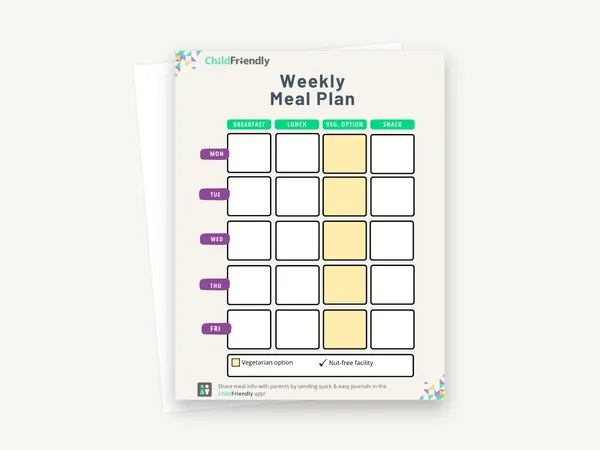
No. It names food groups in general terms, such as pairing sugary foods with protein or fat like cheese or yogurt, but has no menus. Use the Weekly Meal Plan Template for planning.
The guide’s advice is to look for patterns over time and communicate objectively with families. Describe what you observed and when, and avoid labels.
More templates
Child Development & Programming
Child Development & Programming
Child Development & Programming
Child Development & Programming
Keep learning
Directors & Admin Workshops · Recording
Mealtime in child care settings can be one of the most challenging parts of the day.
Watch the recordingNewsletter
We add new templates and tools most months. Subscribe and they land in your inbox — along with Lunch & Learn and Learning Lab invitations.
Join hundreds of child care professionals across North America. CASL compliant.
You can unsubscribe anytime. CASL/CAN-SPAM compliant.