Draft reports during the week, not the night before
Ten minutes a day across two weeks is far less painful than a weekend of catch-up — and the examples are fresher.
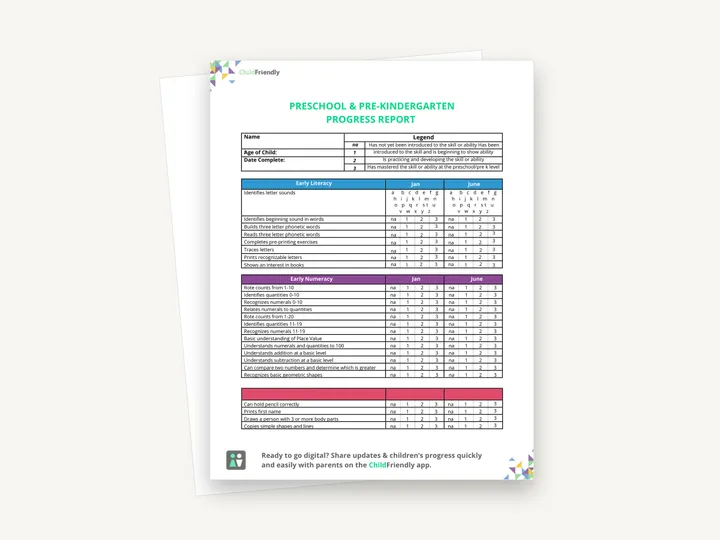
A two-page progress report for preschool and pre-kindergarten children. Educators rate skills in early literacy, early numeracy, fine motor, gross motor and social & emotional development in January and again in June.
No sign-up required. Print it and share it with your team — it’s free for any child care program to use.
What’s inside
How to use it
Tips from operators
Learned the hard way across 3,000 child care spaces — and from the directors and educators who join our Lunch & Learns and Learning Labs.
Ten minutes a day across two weeks is far less painful than a weekend of catch-up — and the examples are fresher.
When you talk through the report, open each area with something the child does well, then the growth area. Families hear the second point only if they trust the first.
If every child is marked 3 on everything, the report stops meaning anything. It’s fine for most 3-year-olds to be at 1 or 2.
Do it digitally in ChildFriendly Pro
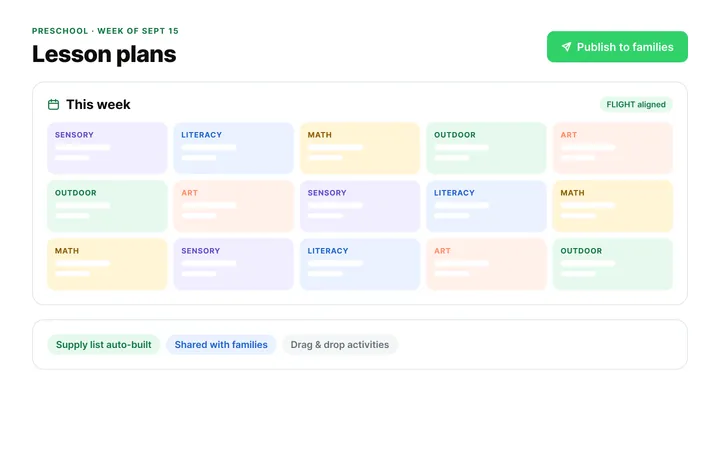
Build the same plan in ChildFriendly Pro and every observation you log is tagged to FLIGHT, ELECT, ELF or your own outcomes, added to each child’s portfolio and shared with families in their daily journal.
FAQ
Can’t find your answer? Chat with a real person who has run a child care center.
Read more FAQsTwice a year is the norm, and this report is laid out that way, with a January column and a June column. Whatever cadence you choose, tell families in the parent handbook so it is expected.
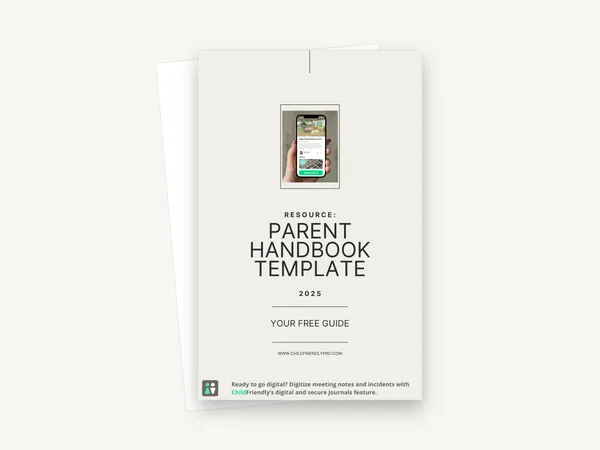
No. It is a general skills checklist covering early literacy, early numeracy, fine and gross motor, and social & emotional development, so it can sit alongside any early learning framework (FLIGHT, ELECT, ELF, ELOF, state pre-K guidelines).
Yes — the skills listed cover much of what kindergarten teachers look for. The June ratings give the family a clear picture before school entry.
Absolutely. The legend is printed at the top of the report; explain it at orientation and again at the conference. ‘na’ only means a skill has not been introduced yet, and 1 or 2 is a normal, expected stage.
More templates
Child Development & Programming
Child Development & Programming
Family Engagement
Family Engagement
Keep learning
Educator (ECEs) Workshops · Recording
Play-based learning is powerful—but sometimes it can be difficult to clearly explain the why behind everyday activities.
Watch the recordingBlog · Parents & Families
3 min read
Read the articleCompliance guide · Alberta
Ratio & compliance
Read the guideNewsletter
We add new templates and tools most months. Subscribe and they land in your inbox — along with Lunch & Learn and Learning Lab invitations.
Join hundreds of child care professionals across North America. CASL compliant.
You can unsubscribe anytime. CASL/CAN-SPAM compliant.